
What It Actually Takes to Make a Truly Fragrance-Free Soap
If you've ever wondered why truly fragrance-free products are so hard to find, this post is for you. Episode three of building Kynd Today we're getting into the part people don't usually see: the ingredient standards and manufacturer requirements that make a product safe enough to put on our label.
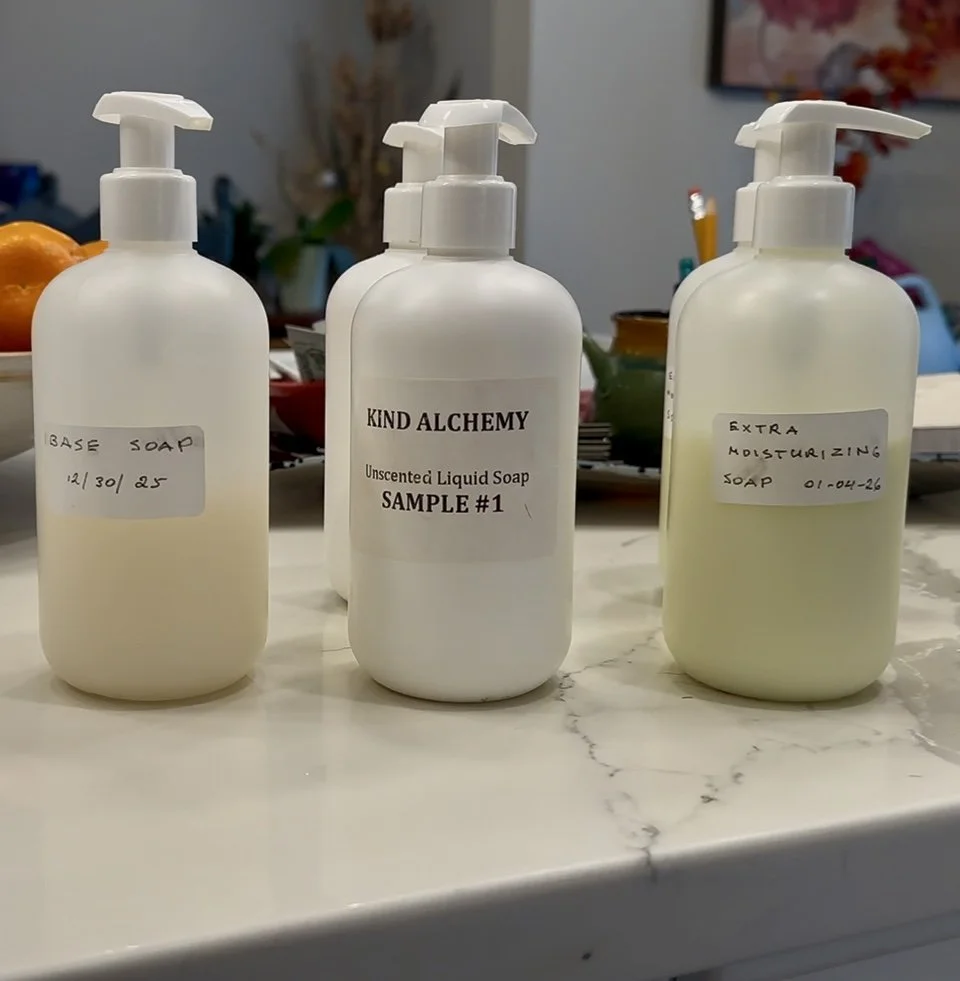
Manufacturer samples of Kynd Alchemy hand soap
Most fragrance-free products are an afterthought
I've tried a lot of them. And I'd say about 95% of what's marketed as fragrance-free was made by brands that treated it like a secondary concern — something to check a box, not something to actually design around.
The result? Formulas that are runny, drying, or have a strong chemical base odor. And then there's a problem that almost no one talks about: cross-contamination. A lot of these products are produced and stored in the same facility as heavily fragranced ones. The soap itself might not have fragrance added, but if it's sitting on a shelf next to products that do. For people with real sensitivities, that's not a minor detail. It can cause actual reactions.
Video showing fragrance-free products on a kitchen counter
Our formula standards
Here's what we're working toward: a soap that is biodegradable, pH-balanced for skin, and genuinely moisturizing — not that tight, stripped feeling you get from most soaps. Creamy in texture, not watery. And absolutely no fragrance, essential oils, or masking agents of any kind.
That last part matters more than it sounds. Natural ingredients aren't automatically safe. A lot of essential oils and botanical extracts are major allergens — lavender, citrus, tea tree, all of them. So we're not just removing synthetic fragrance and calling it done. We're choosing every ingredient with the goal of minimizing known triggers while keeping the base odor as low as possible.
Natural doesn't mean safe. That's one of the most important things I've learned going through formulation.
Our manufacturer requirements
This part was a hard lesson early on. I ordered samples from several labs when I was first vetting manufacturers. More than one arrived smelling like perfume, not because fragrance had been added to the formula, but because the products were being stored and produced next to fragranced items. That immediately disqualified them.
The manufacturer we work with has to meet a set of non-negotiables:
— Must be able to produce 100% fragrance-free soap
— Cannot store or produce near fragranced products
— Must be fully transparent about their raw ingredient suppliers
— Must voluntarily follow EU cosmetic standards (which are significantly more rigorous than U.S. regulations)
That last one matters a lot. The EU bans or restricts over 1,600 ingredients. The U.S. FDA has officially banned eleven. We hold our manufacturing to the higher bar.
Where we are right now
Our cosmetic chemist is currently experimenting with an alternative ingredient to the one used in our first three samples, specifically to reduce the natural base odor. I'm still testing rounds myself and studying formulation so that I can give real, informed feedback rather than just impressions.
It's taking a little longer than I originally hoped. I was aiming for a March launch. That has shifted to the Summer, and I'd rather tell you that directly than overpromise. This product is being built to last, and that means not rushing the formula.